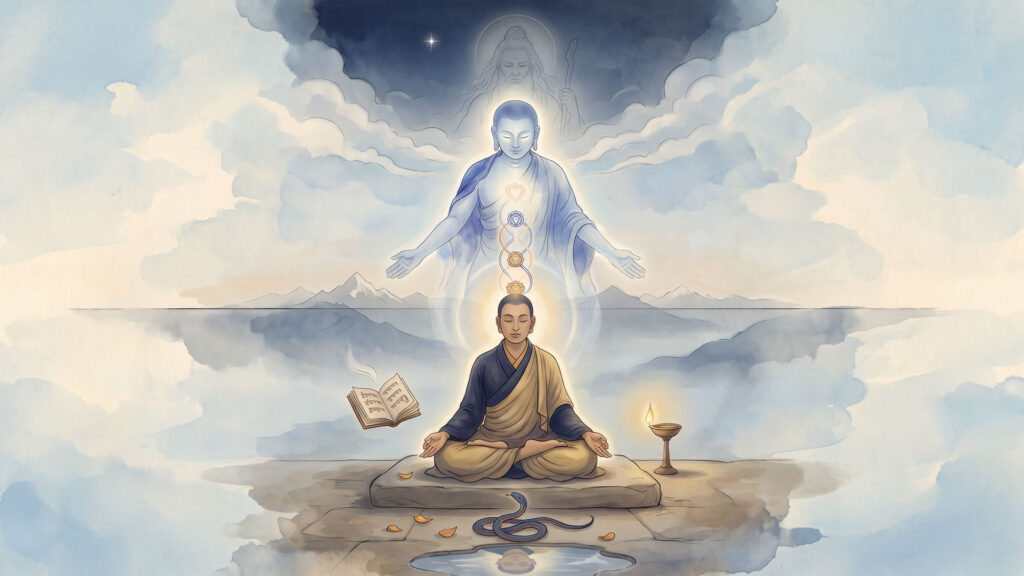



Yoga is a very broad subject of spiritual development. Yoga is the essence of all religion, the essence of all mysticism, the essence of all spirituality and spiritual development. Yoga distinguishes eight groups of exercises, which have become known as ashtanga – eight limbs or the eightfold or eighth path. Yama, Niyama, Asana, Pranayama, and Pratyahara are five more basic groups of exercises sometimes referred to as lower aspects of Yoga, and overall easier and more generally accessible. Classical Hatha Yoga is based on these five comprehensively practised groups of exercises, with Asanas as the central point of balance around which the entire training of perfecting a human being towards divinity revolves. The next three groups of exercises, called the higher part of Yoga, are Dharana, Dhyana and Samadhi, or internal work on developing the ability to concentrate attention, meditation and focus on the Supreme. When the main burden of practice is placed on the higher three aspects of Yoga, we are dealing with methods of spiritual development such as Kriya Yoga, Raja Yoga or Laya Yoga. Of course, some serious general foundations of practising Yoga are always necessary to effectively use these more internal methods of spiritual realization of the Self or Soul, the Atman. In Vedic times, Yoga was one Yoga, and the differences in the contacts of its practice were more associated with the temperament and character of its main Master, Guru than with systemic differences, as in modern times, where apparent systems try to compete with each other unnecessarily. The level of development of students determines whether they need to be taught more about the principles of Yama and Niyama, i.e. the foundations of spiritual life in the human form of existence, or more about Asanas and Pranayamas, or more about Pratyaharas and Dharanas for purifying the subconscious, controlling the senses and concentrating thoughts. Unfortunately, in the modern era, it is rather difficult to find more spiritually advanced people who would be able to practice yogic methods from more advanced groups. Otherwise, billions of people would practice Kriya Yoga, Raja Yoga or Laya Yoga. Humanity has difficulty approaching the most elementary methods of practice such as Hatha Yoga, Mantra Yoga, Karma Yoga or Bhakti Yoga, and deeper and more powerful yogic methods leading to the Realization of the Self, Atman, are very rarely practised by a small spiritual avant-garde of humanity.
(2) The ancient discipline of spiritual development comes from the devas, gods and goddesses from Heaven; it is indeed very old, universal and beneficial, allowing human beings to transfer their consciousness from the human kingdom to the spiritual kingdom, also called the fifth kingdom of nature. We have the consciousness of the kingdom of minerals, plants, animals, and humans; we have the fifth kingdom in which souls exist, which the ancients called the kingdom of the soul, purusha. Yoga is based on exercises, on practising; therefore, sadhana or a set of yogic exercises appropriate for a specific person, group, or type of people, is called yogic practice. There is no Yoga without sadhana, which is performed regularly by sadhakas, practitioners aspiring to higher stages of spiritual development. Yoga is always Vedic, as a whole and comes from God, from Śiva Yogeśvara, the Master and King of all people, who has followed the secret path of inner transformation, leading souls from the human kingdom to the spiritual kingdom. Yoga is the most scientific technique that saves humanity from misery and the final destruction of units of consciousness called souls, selves, or atmans. Yoga leads man straight to the realization of Brahman, where the separated soul reunites with Brahman, the All-Spirit, the Luminous Essence of Creation. Brahman is the goal of all individual human units called souls, selves, atmans. The methods of practical exercises, including moral considerations, body training, breathing, purification of the senses, concentration and meditation, are called Yoga. Generally, Yoga is divided into four great circles or stages of practical exercise of methods related to the degree of advancement in the process of inner transformation towards reunion with God, with Brahman, the Primeval Self. We have four Padahs, four great circles, regardless of whether we practice Mantra, Bhakti, Jnana, Hatha Yoga or Kriya Yoga, Laya Yoga or the royal Raja Yoga of the Masters of Wisdom, which should be remembered by all who consider themselves aspirants of any particular variety of yogic practices, including tantric ones.
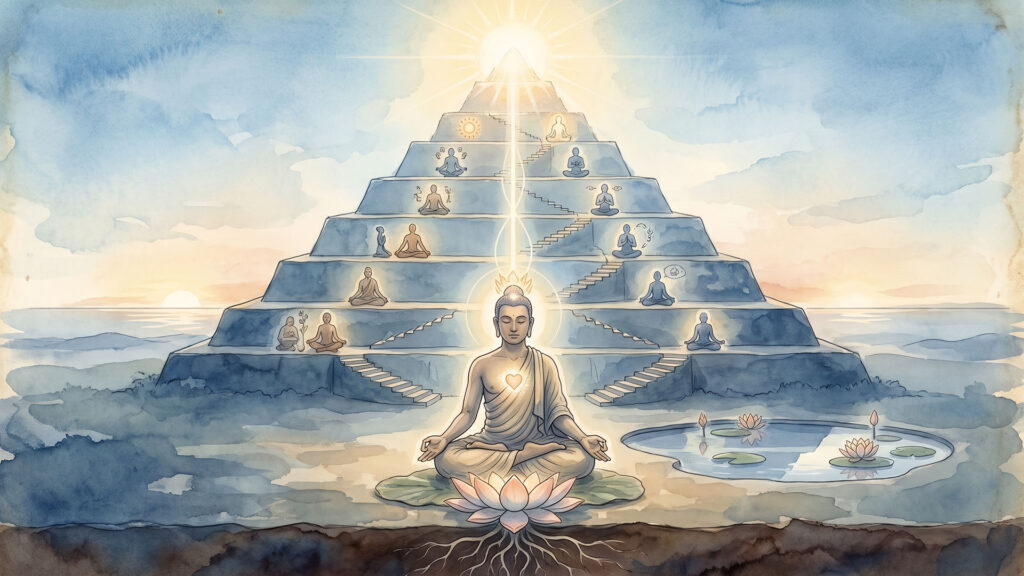
(3) Samadhi Padah is the first great circle of yogic exercises considered basic. Kriya Padah is the second great circle of yogic exercises, which we can consider intermediate or mystical-ascetic. Vibhuti Padah is the third circle of yogic exercises that is considered more advanced or higher because it is practised by siddhas to develop miraculous yogic powers. The last stage is the practice of Kaivalya Padah or the fourth circle of yogic exercises for very high-ranking adepts who are not far from liberation from the circle of earthly incarnations. Yoga leads through these four main stages of spiritual development towards final liberation from the circles of samsaric suffering. Samadhi, Kriya, Vibhuti and Kaivalya are four stages, four great circles of yogic practice, and four great stages of spiritual development of a person travelling the path of the return of souls to the Kingdom of Heaven to Devachan. The first Master and Founder of Yoga, Shiva Yogeśvara, established Mahayoga, where we have four detailed methods of journeying through the four stages mentioned above of the path of Realization of God, Brahman: Mantra Yoga, Hatha Yoga, Laya Yoga and Raja Yoga. Each of the following is slightly more difficult to practice than the previous one. Hence, Mantra Yoga is considered the basic and easiest to practice for the general population, whose religious simplification in the form of Bhakti Yoga is the most famous preparatory approach to practising Yoga in the world. Raja Yoga is sometimes so difficult for humanity that avatars, emanations or descents of Śiva Yogeśvara taught a simpler version of the Royal Yoga of the Rishis known as Kriya Yoga. It should be remembered that to achieve the ability to practice Raja Yoga, it is worth starting with Kriya Yoga, thanks to which, in time, we will acquire the ability to practice in the manner of the heavenly Masters of Wisdom. Yoga is Mahayoga, the Great Yoga if we want to practically use certain sets of exercises and rules for the benefit of people or rather souls with different potentials or abilities to devote themselves to both the practice of yoga and the path of spiritual Realization.
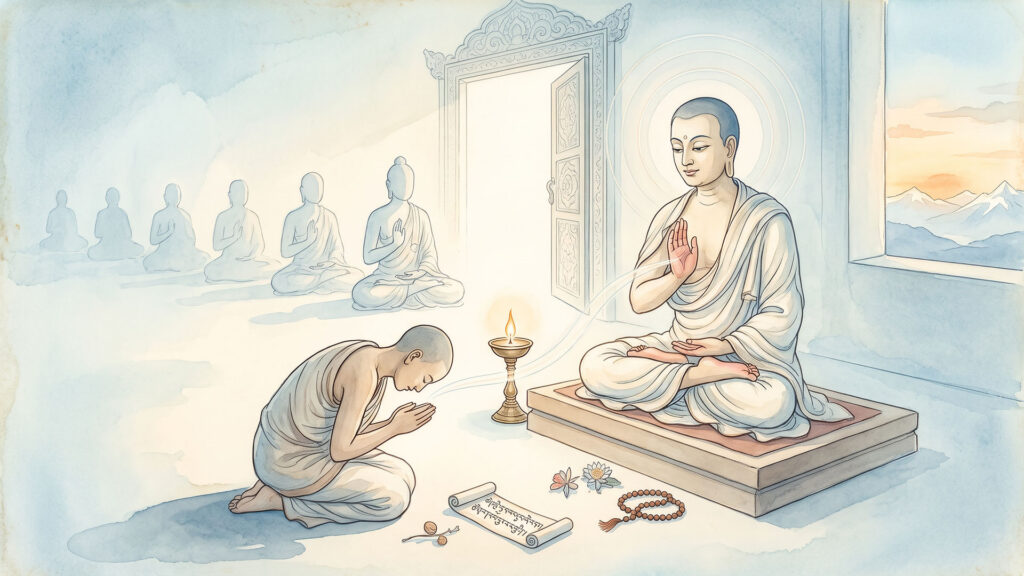
(4) Yogic methods such as Raja Yoga are closest to the Masters of Wisdom, the Rishis, but it is Laya Yoga that is closest to God the Giver of Yoga, and it is Laya Yoga that is practised by the entire Aśram of Śiva Yogeśvara, by the Ganas and Devas from the entourage of Śiva God and the King of Yogis. It is not easy to become a Gana (a disciple of Śiva and his Śivaćaryas) because a person’s karma must be good enough; otherwise, he will not meet a Master of Laya Yoga in his life or anyone who can teach Laya Yoga. The subject of Guru is a river in the spiritual development of man. Every teacher or master of the path of spiritual development of man teaches that the soul of the disciple needs the master’s soul, whose touch allows both final purification and final turning to divinity. There is no path of spiritual development without the Guru because the Guru is a liberated soul, a realized soul, a soul that has the power to care for and intercede for the souls of all those seeking the Path of Liberation. Upaguru and Aćaryas are advanced teachers who, on behalf of the Master of Souls, can teach and help the souls of disciples seeking the Path of Return to Brahman. Upaguru literally means Half-guru, Half-masters, just as Upadeva means Half-gods, beings close to realization, to achieving the state of being a Guru, but who still have long-term perfecting works to fulfil on this earth. Each Guru attracts to his mission on earth several, usually four, seven or twelve Upagurus, who can be recognized by the fact that they accompany the main Master of the spiritual school throughout their lives, and after his death, throughout their lives, continue his work of teaching and guiding students in harmony with the other Upagurus. Vedic Masters, especially Rishis and Maharishis, left the established Yogic Ashrams in the hands of the Guru’s successor, becoming Paramaguru for their aśrams, for all spiritual students. There is no Yoga without a Guru, and where the role and importance of the Guru are diminished or denied, there is no spiritual development of man or real inner transformation of people into souls of a higher, divine kind. Modern people are sometimes afraid of the word Guru, but they should remember that this concept means the highest class specialist in a given field; in relation to Yoga, it is, therefore, a specialist of the highest quality in the field of metaphysics, spiritual development and evolution of souls and especially in the field of the practice of spiritual development of human and angelic, devaic beings.
(5) Nowadays, in the 20th and 21st centuries CE, Yoga is mainly taught based on its foundations, especially in the West, regardless of whether Bhakti, Mantra, Hatha, Laya, Jnana, Kriya or Raja Yoga is taught, usually very simple, elementary foundations are taught, because even people who are more sincerely interested in spiritual development, alchemical internal spiritual transformation are usually only at the beginning of their interest in the spiritual path of developing consciousness. The foundations cannot be omitted because the entire edifice of spiritual metamorphosis is built on foundations, and without good foundations, every house, including the spiritual one, will collapse, forcing the whole work of developing the soul to start from the beginning. It is worth remembering that Raja Yoga, and to some extent other systems, are based on auxiliary yogas showing certain necessary aspects in the spiritual development of men, such as Karma Yoga, Bhakti Yoga or Jnana Yoga. There is no entry to higher levels without passing such stages or aspects of yogic training more deeply, at a very good level. Yoga and its Masters have taught since Vedic times that spiritual development results depend on high-quality practice or work. The work of spiritual transformation must be done in every required aspect at a decent level, and the merit of every method of authentic Yoga is its versatility, thanks to which this is possible. There are no quick or immediate paths to enlightenment or spiritual liberation, and progress in spiritual development is generally measured in Jupiter cycles, in cycles counted in twelve years. It can be said that the period of intensive practice or cycle of spiritual development under the guidance of a living Guru is the period of Twelve Years, during which Jupiter himself is called Guru or Brihaspati among the planets wandering along the zodiacal belt. Twelve years is the cycle of work allowing for the completion of the initiation into Yoga and the taking up of the next, higher lesson of inner development. People in the West who have been searching for many years notice this very well when they see that after decades of naively spending themselves on a solitary spiritual search and morbidly denying all gurus, they discover that they are actually going in circles. Without the expert help of someone with real spiritual power, they will not take a single step further. The true practice of Yoga requires a Guru whose students accept without a shadow of a doubt, a Guru with whom one can walk the path, practice and learn for millennia, and not for a few years or meetings. True Yoga begins when you meet a Guru.
Many Blessings on the Path of Awakening and Realization! Om Namaśśivaya!
HUM!
The Himalaya Master