


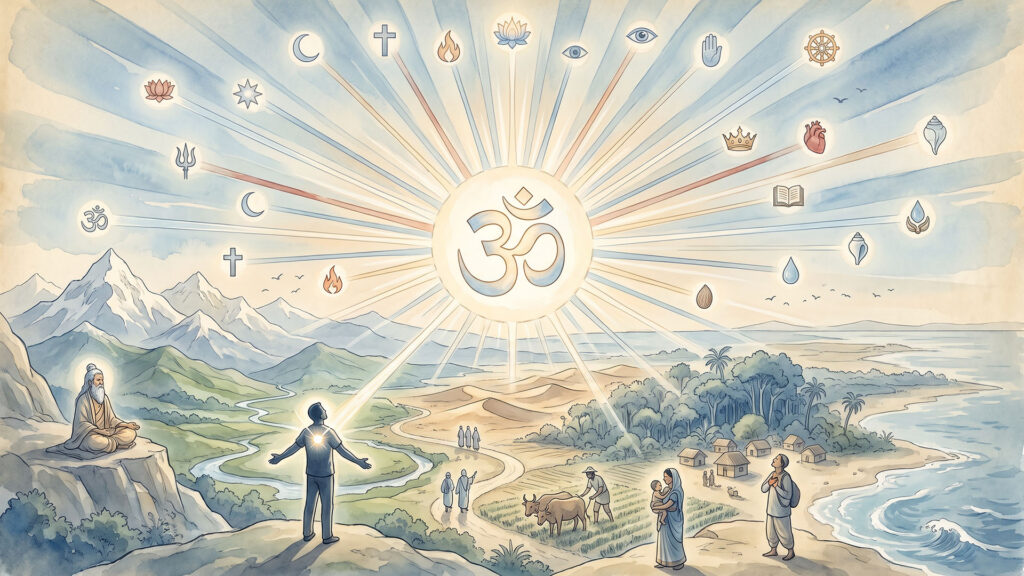
Many think and proclaim that God (Brahman, Śiva, Elohim, Allah) is Love (Prema, Agape). The problem is that God is not just love. God has ten thousand such attributes as love, and love itself is not God but his poor caricature because, figuratively speaking, it is 1/10,000 of what God is in his properties and energies. It is as if you, human, were mistaken for a hair on your head, or a piece of your fingernail, or perhaps a bit of your saliva. Limited people do not want to hear about the 10,000 attributes of God and, in this way, cause a total distortion of perception and understanding of God through the prism of one attribute. In this case, it is a bhaktic (devotee) distortion, regardless of religion, occurring as a sign of degeneration of spirituality and mysticism in the dark period of the existence of the human world. Popular practices of contemplation and recitation of the 108, 300 or 1008 Names of God show the most important aspects of spiritual development for humanity. How little do people have of God if they have significantly developed a dozen or several dozen divine attributes, aspects, characteristics and properties. There are also traps in divine names because some of the Names of Divine Beings, due to their significance, are not suitable for spiritual practice in humanity. From the East, such an example is the name-feature “Krishna” because this word means darkness, gloom, evil or dark spirit. To practice with a person with such a name, you need some solid mental gymnastics, including good identification of the character in question and realising the features of this person with a positive meaning, such as Gopala or Govinda. Otherwise, repeating or contemplating the word “Krishna” will lead to darkness, gloom and chaos and can also transform a person into an evil spirit of darkness. Then, we are talking about realising the name as a feature or characteristic, which means becoming darkness.
(2) People practising spiritual development and yoga in America or Europe usually talk a lot about the transformation of the Heart and even practice a lot with the transformation of the heart. However, although very important, the Heart is not all that needs to be practised to progress on the spiritual path. Sometimes, as teachers and guides, we ask such people who are totally involved in the transformation of the heart whether they would also like to transform their mind, memory, instincts, lusts of the womb and old conditions into something better than before. In the East, KARMAN, the whole of conditions, transforms, but it has little to do with the heart. KARMAN gathers in the Lotus of the Base, in the muladhara where instincts, lusts and sexual desires are. To transform karman, one must practice a lot with purifying the sphere of the muladhara; one must develop and consolidate good spiritual concepts that help to fully realise the mandala of the root centre or the base of the torso. The Vedic deities associated with the mandala, which is the foundation of spirituality and the transformation of karman, are Indra, Brahma, Saraswati, and Gayatri. The four-way division from the sides of the world, the ideal of the four castes of humanity, the square altar, and the Vedic house on a square plan are the primers of spiritual development from the ground up. Indra is the development of strength, endurance, and fitness for the soul’s development, i.e., training in hatha yoga, prana yoga, or kalaripayat (martial art). The ideal of Mother Earth in the form of the goddess Prithivi, Ila or Bharati is most necessary, and in addition, the awareness of the four elements of nature and spiritual power in the form of the Sacrificial Fire, Kundali. Indra is the king of yogis in the heavens, the king of the Kingdom of Angels known as Swarga. Therefore, accepting such teachings about the soul and the kingdom of angels (heavenly deities) is most good and helpful for developing souls.
(3) The soul, the dweller of the body and mind, is called in Vedic terms Atman or Purusha. Atman (Atma) is not known through awareness. The level of Ćittam or awareness does not reach Atman because it is lower. The concept that there is no awareness of Atman (Atma) is totally wrong and illogical in relation to the teachings of dharmic spirituality from India and Tibet. Consciousness (Ćit, Ćittam) cannot fathom Atman. The realisation of Atman is called spiritual realisation or self-realisation. However, no such thing as one’s own path leads to Atman’s realisation. The whole idea of the so-called one’s path is just satanic gibberish, the gibberish of worldly Satanism and its ideology of people sick with exaggerated egoism and egotism. The spiritual path is the Path of Heaven, of God. If someone babbles about their own path, then they are either a programmatic Satanist or some Satanists have brainwashed them. Every bona fide authentic Spiritual Master presents the Path of God, the spiritual path, but it is not anyone’s own path. We can say that human lives can be very different, but the path to Heavenly Heights is one and always the same for all people. We need to develop the same features, properties, and qualifications that will determine whether we become luminous heavenly beings with the right to enter the heavenly plains and palaces. People’s own paths lead to the dark spheres of hellish existence, which is clearly visible in the history of all humanity. We ask God, or the deities of heaven, called angels and archangels in the West, in this way: “Lead us in Your Divine Path, lead us in Your Path, God, towards Heaven, towards Your Kingdom!”
(4) With true spiritual teachers, people who forget the knowledge they have learned have it worse because masters and their aćaryas have a habit of not only teaching and passing something on but also asking questions, both on an ongoing basis, about what has happened, and during subsequent classes. On the advice of eastern ṛshis (sages) and gurus, one simply asks questions and checks students’ progress. There are no further initiations without consolidating knowledge and working through the practices assigned by the spiritual teacher. This is a simple and effective method, not only in yoga or martial arts. If someone comes after a break of several years in practice, study and work, they usually start from the beginning unless they pass the exams of knowledge and practice. If someone wants to work as a spiritual leader, they have to pass many practical tests, so many who want to get into workshops for spiritual yoga teachers or tantra do not make it because they simply do not pass the qualification tests, either in knowledge or practice. This prevents people with low qualifications and people without understanding and experience in practice from being admitted to yogic teaching circles. Masters see many candidates for leaders of spiritual groups and candidates for teachers, but only a few pass all the required exams, both in knowledge, practice and life.
(5) Vedic culture is very strongly based on the ideas of the Primordial Goddess, the Mother of the Universe. In Vedic culture, Aditi is a goddess, the mother of gods (devas). Adi means the beginning, the first freedom, justice, infinity, and the highest sphere of existence. Aditi can be understood as the Supreme or First Mother, the Mother of Gods. Aditi is the goddess of freedom and justice, the solar goddess. Her most important son is Aditya, which means the Sun, the First Sun or the Supreme Sun. Aditya is also a group of gods, all the sons of Aditi. Depending on rank, this group includes seven, eight or twelve Vedic deities. Rigveda II.27.1 mentions the names Mitra, Aryaman, Bhaga, Varuna (Varuna), Dakshan, Amśa (Anśa). Rigveda X. 72.8 adds the names Aditya (Surya) and Martanda. Other texts also mention the names Dhatr (Dhatar), Indra and Vivasvat. Names such as Pushan, Parjanya, Tvashtr (Tvashtar) or Vishnu are mentioned in many other texts, including the Puranas. Mitra and Varuna are considered the most important brothers and sons of Aditi. Esoteric texts of the Vedic era also mention the hundred sons of Aditi – the Divine Mother. It seems that the mention of Aditi in the Vedas is the oldest trace of the Goddess – the Mother of Gods (Devas) in the history of humanity, especially in Indo-European culture, in the spirituality of the Aryan (Noble Ones). Aditi is also mentioned in the Rig Veda itself as Mena or Menaka. We have more names of goddesses mentioned in the Rig Veda, including Ila, Prithivi, Sarasvati, Bharati, Durga, Priśna, Gayatri, Agnayi, Indrani and Varuni. On the one hand, all these beings are aspects of the Mother Goddess Aditi; on the other hand, they are independent names of goddesses or archangels of Heaven. It is worth remembering that the teachings of the Vedas clearly teach that an astika – a theist (a believer, spiritual, religious) is a person who accepts the authority of the Veda, worships the Vedic deities (devas), displays moral values prescribed to people by the Vedas, while a person who denies, rejects the Vedic knowledge and authority of the Veda, does not worship the Vedic deities (all) is a nastika – an atheist (a non-religious, godless, non-spiritual person). It should also be remembered that God is the entire Vedic pantheon, i.e. All the Deities of Heaven Together (Vishvedevas), like a spiritual Board of Swarga-Loka (Heaven), and not a single deity because the deities interpenetrate each other and act together as one being manifested in many aspects, which is sometimes difficult for Westerners to understand.
Many Blessings on the Path of Awakening and Realization! Om Namaśśivaya!
HUM!
The Himalaya Master