

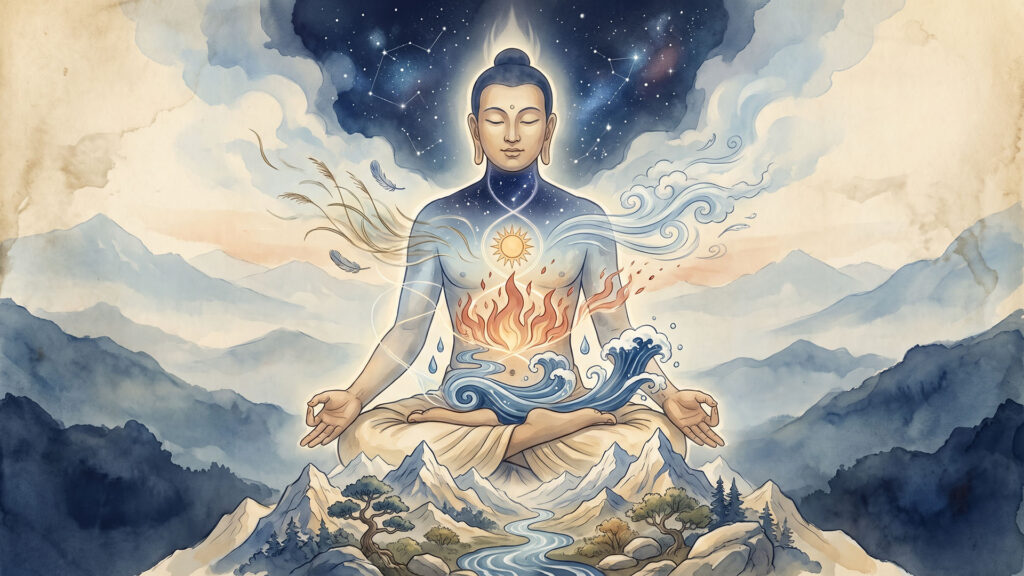
Kriya Yoga is known as a simplified Raja Yoga, and like Laya Yoga or Raja Yoga, it practices certain elements of the ancient secret knowledge of subtle centres called ćakras. A very practical method is the awakening of the seven subtle Fires in each of the seven main ćakras of the body, as well as practice with the vibrations of the elements. Kriya Yoga, like Laya Yoga and Raja Yoga, attaches great importance to the sounds of the elements of nature, such as Lam, Vam, Ram, Yam, Ham, and Om and Aim. The five great elements, the spirits of nature, are expressed and experienced not only by chanting the five syllables of the elements but also by concentrating on their sounds in the ćakras or listening to the sound of the element during deep, very focused meditations. The five centres of focusing attention in the torso correspond to the five elements, the most important of which is Akaśa, an element embedded in the lotus of the throat at the base of the neck expressed by the vibration of the syllable Ham. The sound “Ha” in Sanskrit corresponds to the sky, spirit, soul and divinity, hence it is assigned to the lotus with sixteen petals, which is also considered to be the seat of the spiritual Fire, the Fire of divine aspirations, desires and needs of the development of the self towards divine perfection. The Viśuddha centre, as the lotus of the throat is called, is associated with the memory of the vibrations of sound, voice and speech, with clairaudience, speech and the so-called Akaśa chronicles, i.e. what is recorded in the structure of space, the void, in which forms created from the four coarser elements of matter are placed. In the heart centre, we have the sound of the wind or air element marked as the syllable Yam and the sense of touch and feeling associated with it. In the solar plexus centre, we have the sound of the Fire element marked by the vibration of Ram and the sense of sight, seeing, and perception associated with it. In the sub-umbilical centre, we have the sound of the water element marked by the vibration of the syllable Vam and the sense of taste and liking associated with it. In the centre at the base of the spine or even the torso at the level below the tailbone, we have the sound of the earth element marked with the vibration of the sound Lam and the sense of smell, sensitivity to smells, the ability to feel and distinguish various smells associated with the earth element. When practising Kriya Yoga, one should be very careful of its degenerate modern versions coming from channellings and not from authentic spiritual masters, Vedic Rishis and divine Gurus, which can be recognized, among other things, by the fact that they remove the spiritualizing syllable Ham – always the seed mantra of the throat lotus, and replace it with the syllable Śam, which is a serious abuse that makes it impossible for a person to develop spiritually at more advanced levels of practice. There are many such errors in modern, new-age forms of degenerate “yoga”, including the degenerate “Kriya Yoga” that comes more from America and California than from India or the Himalayas.
(2) The centre of the earth element, muladhara, is associated with acquiring the means necessary for life, including earning money. Originally, this centre allowed for farming, harvesting crops, hunting, and everything a person has to do to survive in nature. The family’s defence of life and protection also belongs to the base centre, also called the coccygeal or sacral centre. All work is associated with the root centre, the muladhara, the reservoir of the basis of human life and what largely connects humans with animals, such as sleeping, eating, reproductive activity, and obtaining means of living. In humans, obtaining means of living is extended, although sometimes it is limited to collecting what others throw away or what nature gives birth to. Modern man devotes much time to work to earn a decent wage, so Karma Yoga becomes the basic practice of spiritual development in the muladhara lotus ćakra, where the vibration in the form of the syllable “Lam” rules like a queen. It is worth giving yourself some time to understand the principles of good prosperity and to develop an awareness of prosperity based on practices and principles derived from the awareness of the coccygeal sacral centre. The first Flame of Fire that develops is the Flame of Support, Donation and Giving, Dakshina Agni, which animates the Muladhara. Dakshina means Donation, Charity, Offering and Support, which in spiritual life is the ability to live from alms, donations offered and the ability to give donations or support for others in need. Dakshina is also the proper provision for those who are dependent on us.
(3) The centre of the water element, svadhisthana is considered the centre of erotic and love desires, the centre of development and sublimation of sexuality. The first ćakra is responsible for reproduction, and the second is the love and erotic life of a person, practised more for pleasure than for procreation. Taste combined with aesthetics, good taste, the desire for a suitable partner, love and erotic fantasies, all this is astral work in the second centre, sometimes called the centre of sex or eroticism. Desires for sexual intercourse dominate a person when the second centre from the bottom of the torso is strongly awakened and dominates the human consciousness. In this centre, the need to know the Self, to realize who and what a person is, also awakens, and this is because “Svah”, the Self, the I, is embedded or attached to this second centre. People here have incredible erotic-love fantasies and desires combined with the individualization of the Self and strong egotism resulting from the awakening of the element of individuality. Adepts of the path of spiritual development in this phase have short and complicated love relationships, a high or even exaggerated opinion of themselves, and they like to perform spiritual practices as pratyekas, i.e. individualistic practitioners who follow the path alone. The inability to control strong love-erotic inclinations and entering into new momentary loves shows that this is still a stage of practice within the scheme of the second lotus with six petals. The purification and elevation of the water centre take place with the help of strong practices with the syllable “Vam”. In the second centre, we develop the Butter Flame offered to the deities in a fire offering, Grihapati Agni. The awareness of the sacrificer and servant, the owner of the sacrificial fire and the leader of the family, household, and clan or community develops.
(4) In the centre of the fire element, animated and developed by the fiery syllable “Ram”, the human appetite is awakened and controlled, hence the quality of food, the way of eating, the mystical asceticism in the form of fasting, all these are aspects of the work of spiritual development in connection with the lotus manipura, the garden of treasures and jewels. Adventurers, treasure hunters, and people who reveal the secrets of nature and natural resources originate from the consciousness here, in the third focal centre. It is not only people who follow their appetite for the food they consume. In the third torso centre, we purify, awaken, develop and strengthen the Flame of Humanity, Humanitarianism and the sense of Humanity, Vaiśvanara Agni. Nara means Man, Humanitarian Human Being, the World of People, and Vaiśva-Nara literally means All-Humanity, the sense of humanity, the sense of being a human being.
(5) The heart is a great subject of spiritual development, a great centre of every system of yogic practices. In the heart centre, we have conscious mutual relationships between people, partnership, friendship, joint work and activity, and cooperation. In the heart centre is the seat of the flame of the incarnate self, something like the shape and form of the atman, the soul in a given incarnation, which yogis call the Jivatman. The vibration of the sound of the syllable “Yam” allows for the development and sublimation of everything associated with the heart centre with twelve symbolic lotus petals of subtle energy. The heart is the seat of the wind element, air, Vayu, including the ability to breathe, and also a great magnet enabling us to attract what we want and repel what we do not want. Air enters the lungs through the area around the heart lotus, usually associated with higher feelings, without which man is only an animal, a psychopath, or a monkey with a humanoid shape. Higher human emotions are maitri, or friendship and kindness towards good people; karuna, or compassion and sympathy towards the suffering, which is expressed in sacrificial assistance to the wronged or sick; mudita, or satisfaction with the good and wealth of those who are rich, which allows us to enjoy both our own and other people’s successes; upeksha, or stoic peace towards evil and bad people, peace that allows for proper judgment and punishment of criminals. Higher and subtle emotions that are too sensitive can cause neuroticism of the personality and emotional oversensitivity and, as a result, hinder proper spiritual development, and the experience of the element of the incarnated soul can even stop further proper spiritual development towards the Realization of God. In the heart centre, the fourth Flame of the Seven Fires of Divinity in the ćakras is lit, known as Ahavaniya Agni, the Flame of the Inner Sacrifice offered in the heart chamber. This is the Flame of subtle yet fiery and ardent higher emotions.
(6) The Viśuddha Centre, a sixteen-petaled lotus at the base of the throat in the neck, is a spiritual lotus, the seat of the fifth element, the element of space called Akaśa. In this subtle spiritual lotus, knowledge received from oral transmission is absorbed; here, the words of the masters transform man spiritually, becoming the seed of metaphysical knowledge and wisdom, and the scholars grow a little beyond books and everything that is already known and described. Here, the need awakens to reach beyond the ordinary earthly elements towards the Spiritual Kingdom, towards heaven as a cosmos full of stars and galaxies and towards heaven as the seat of angels, archangels, archons, gods and goddesses and other wonderful spiritual divine creatures. The Lotus of Superpurity, Viśuddha, is the beginning of the Fifth Kingdom of Nature, human angels, deities walking on earth, or in other words, the degree of ability to enter the spiritual community, build a body of light and live on the principles of Sanatana Dharma. The syllable “Ham” allows the Viśuddha ćakra to develop, and without practice with the syllable “Ham”, the concentrated vibration of the fifth element, it is impossible to create a heavenly body of light or belong to the true Spiritual Kingdom. The syllable “Ham” means that which is heavenly, spiritual, divine, angelic, and has a potential for advanced spiritual development without which there is no enlightenment, no spiritual Realization of the Self. In some degenerate forms of pseudo-Kriya Yoga, demons and dark and malicious entities have thrown out the work with the vibration of spiritual development “Ham” by inserting another type of syllable, “Śam”, but such a variation blocks the possibility of spiritual development of man for long aeons, which shows how malicious the dark envoys of asuras and rakshasas are to people, who always want to somehow stop the development of man towards God. The syllable “Śam” has its use as a petal of the lotus of the muladhara and promotes the development of states of bliss and happiness, but this is all a relatively early stage of the first lotus, i.e. the coccygeal centre at the base of the torso. Such a regression in development to the base centre is a cunning trap set by Californian demons for naive Western adepts who usually have no idea about ćakras and Kriya Yoga. The conclusion is that people have a lot to learn so as not to be deceived by demonic deceivers who want to force their inventions in place of the teachings of Mahavatar Babaji, not supported by the thousands of years of tradition of the spiritual school of Yoga. In the fifth centre at the top of the torso, at the base of the neck, the fifth flame of the inner fire of the soul is lit, called the Flame of Spiritual Creativity, Samidbhavanama Agni, thanks to which pious prayers to all deities, goddesses and gods of heaven, i.e. beings of the Spiritual Kingdom, are fulfilled.
Many Blessings on the Path of Awakening and Realization! Om Namaśśivaya!
HUM!
The Himalaya Master